
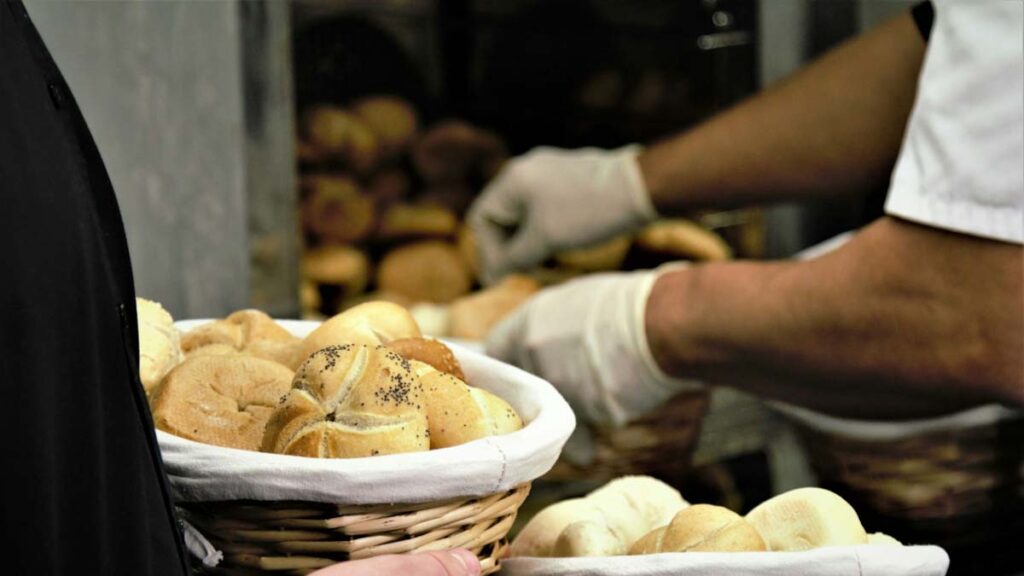
Bread in Italy is part of daily life and culture. In this article, you’ll learn how Italians buy bread every day, where to find the best bakeries, what kinds of bread exist across the country. You’ll also discover the differences between a panetteria, a forno, and a pasticceria, plus what types of bread you can expect to find in Le Marche.
Buying fresh bread every morning connects you with local life, supports small shops, and lets you taste one of Italy’s oldest traditions.
👉 For more on Italian culture and public life, see our article: Italian Etiquette Guide.
Bread in Italian Culture: From Ancient to Modern Times
Bread has been part of Italian life for thousands of years.
Even before the Romans, ancient peoples in the peninsula baked flat loaves using stone ovens.
The Romans later perfected the art, spreading baking techniques across Europe.
Bread was a daily food, a symbol of nourishment, and even a political tool: the phrase “panem et circenses” (“bread and circuses”) still echoes that idea.
In medieval and Renaissance times, bread remained central to Italian families that often baked their own loaves in communal ovens, while city bakeries began to flourish.
Today, bread is still a daily ritual.
Each region, sometimes each town, has its own shape, taste, and tradition.
Types of Bread and Impasti
Italian bakeries use a variety of impasti (doughs), depending on flour, yeast, and hydration.
Here are the most common types you’ll find across Italy:
- Pane comune – the standard white bread, soft inside and crusty outside.
- Pane integrale – made with wholemeal flour, richer in fiber and flavor.
- Pane di Altamura – from Puglia, made with durum wheat semolina and natural yeast. It’s famous for its golden crust and long shelf life.
- Pane toscano – traditional Tuscan bread, made without salt and slightly sour.
- Ciabatta – long, flat, and airy, often used for sandwiches.
- Focaccia – flat, soft, seasoned with olive oil and salt, sometimes topped with herbs or tomatoes.
Every region has something unique:
- Liguria has focaccia,
- Puglia has Altamura,
- Veneto has ciabatta,
- Sicily has sesame-crusted loaves,
- Le Marche mixes them all, and each bakery has its own formula.
Bread in Le Marche
In Le Marche, bakeries pride themselves on personal recipes passed down through generations.
You’ll find sfilatino (similar to a small baguette), treccia (braided bread), pane all’olio, and pane infarinato dusted with flour.
Some bakeries use lievito madre (natural sourdough), others bake pane di Altamura inspired by Puglia’s tradition.
Soft rolls like panini al latte are also common for breakfast or snacks.
Each shop has its own varieties, try a few and you’ll quickly find your favourite.
Panetteria, Forno, Pasticceria: What’s the Difference?
These three words often appear together, but they don’t mean the same thing:
- Panetteria: mainly sells bread and basic baked goods.
- Forno: literally “oven,” often a small bakery that produces both bread and pizza.
- Pasticceria: pastry shop, focused on sweets, cakes, and desserts.
In small towns, one place might combine all three.
You’ll walk in for bread and leave with a ciambellone or biscotti secchi.
On weekends, bakeries often bake maritozzi (sweet buns with raisins or cream), crostate, and ciambelle.
Tips for Buying Bread Daily
- Go early, as many bakeries sell out by noon.
- Bring a reusable bag or basket.
- Ask for “mezzo chilo di pane” (half a kilo of bread) or “una pagnotta” (a loaf).
- Don’t be afraid to ask for a recommendation, most bakers love to share their favourites.
- Try different types: some loaves stay soft for days, others are perfect for toasting.
Related articles:
• How to Behave at Markets in Italy
• How to Order Coffee in Italy
• The Role of Aperitivo in Italy