
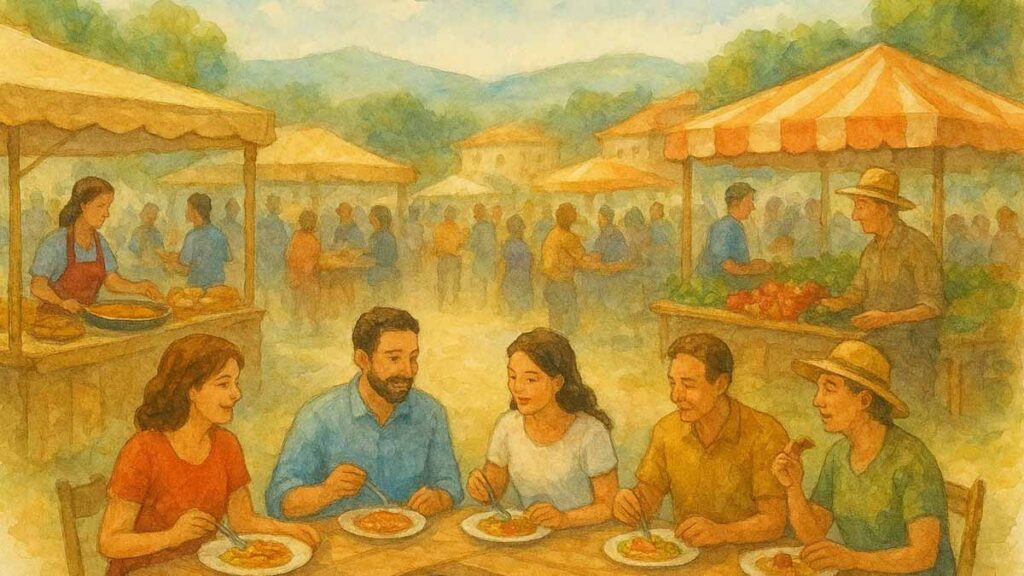
If you spend time in Italy between spring and autumn, you will see signs for sagre everywhere. They appear in small towns, mountain villages, coastal cities.
A sagra is a local food festival. It usually celebrates a single ingredient, a traditional dish, or a seasonal product. Each sagra focuses on one thing: truffles, pasta, olives, chestnuts, wine, polenta, fish, or any local specialty tied to that community. What makes sagre special is the traditions and the people behind them. Let’s explore what makes them unique, why they exist, and which ones are the most beloved ones.
👉 Related Read: Food and Rural Traditions in Le Marche
What Is a Sagra?
A sagra is a community festival created to celebrate a specific food or local tradition. It usually lasts one or two weekends. Some sagre (plural for sagra) run for just one evening; others continue for weeks.
In Italy, sagre are a way to protect identity. They bring together families, volunteers, Pro Loco associations, and entire towns. They are a mix of food, culture, history, and social life — the heart of Italian rural communities.
Every sagra is different, but they share a common goal:
• promote a local dish or product
• support the community
• raise funds for the town, parish, or Pro Loco association
You go to a sagra to eat well, spend little, and enjoy a friendly, informal atmosphere. You might sit at long tables with strangers.
What Do Sagre Celebrate?
A sagra always focuses on one main food. These are some typical examples across Italy:
- Sagra del Tartufo (Truffle)
- Sagra della Porchetta (Roast pork)
- Sagra delle Castagne (Chestnuts)
- Sagra del Cinghiale (Boar)
- Sagra degli Gnocchi (Gnocchi)
- Sagra del Pesce (Fish)
- Sagra della Polenta (Polenta)
- Sagra del Verdicchio or Rosso Piceno (Wines)
- Sagra del Fritto (Mixed fried platter)
- Sagra della Cipolla (Onions)
- Sagra della Pizza Fritta (Fried dough)
- Sagra delle Olive Ascolane (Stuffed olives)
There is no limit. If a village has a tradition, they can build a celebration around it.
Many sagre also include:
- market stalls
- open museums and churches
- live bands
- marching groups
- folk dance shows
- games for kids
- wine tastings
The food, however, is always the center of the event.
Who Organizes Sagre?
This is one of the most beautiful aspects of Italian sagre: they are 100% community-powered.
Organizers include:
1. Pro Loco Associations
Pro Loco are volunteers group associations linked to a comune (municipality) dedicated to promoting local culture. They handle logistics, communication, and coordination. Without Pro Loco, most sagre wouldn’t exist.
2. Local Volunteers
Entire towns participate.
Women cook.
Men grill.
Teenagers (sometimes even children) might bring plates to the tables.
Retirees prepare ingredients days in advance.
A sagra is built by people who genuinely care about their town.
3. Parishes and Committees
Small villages often rely on parishes or neighborhood committees using sagre to fund restorations or community projects.
This is why sagre feel warm, authentic, and deeply human.
How Much Does a Sagra Cost?
Prices vary, but sagre are famously affordable:
- First course: €7–€12
- Main course: €10–€15
- Side dishes: €3–€6
- Wine: €1–€2 per glass
- Dessert: €3–€5
You can enjoy a full dinner for €15–€25, far cheaper than restaurants — and often more authentic.
When Do Sagre Take Place?
Sagre run all year, but the peak seasons are:
- May → September — summer festivals, countryside events, coastal sagre
- October → November — chestnuts, mushrooms, truffles, olive oil
- December — Christmas food fairs and winter specialties
Each region follows its own seasonal rhythm.
👉 Events in Le Marche: The Complete Guide
Why Are Sagre Important in Italy?
Sagre matter because they:
- Keep traditions alive
- Protect local foods, often tied to DOP or IGP labels
- Strengthen communities and attract young volunteers
- Support small towns with essential funds
- Offer one of the most authentic experiences for visitors
If you want to understand Italy, you must experience a sagra.
The Most Beloved Sagre in Le Marche
Le Marche is one of the most active regions for sagre. Mountains, countryside, and coast all influence the food traditions.
Here are some of the most famous events.
1. Sagra delle Olive Ascolane – Ascoli Piceno
Celebrates the iconic fried stuffed olives. Expect crowds, local wine, and long communal tables.
2. Sagra del Tartufo – Acqualagna and Amandola
Acqualagna is one of the world’s truffle capitals. The festival includes:
- white truffle
- black summer truffle
- tastings
- specialty markets
A must for food lovers.
3. Festa del Ciauscolo – Amandola or Sarnano
Celebrates ciauscolo, the spreadable salami typical of the region. Includes cheese and cured meat tastings.
4. Sagra del Fritto – San Benedetto del Tronto
A coastal festival dedicated to fried seafood. Perfect for summer evenings.
5. Sagra del Vino Cotto – Loro Piceno
One of the oldest sagre in Le Marche, focused on traditional cooked wine vino cotto.
6. Sagra della Polenta – Mountain Villages
Autumn events celebrating rural mountain cuisine. Warm dishes by the fire.
7. Festa della Pizza – Many Small Towns
Entire towns turn into open-air pizzerias during summer.
What to Expect at a Marche Sagra
Typical features include:
- Long shared tables
- Simple paper menus
- Ticket booths
- Volunteers cooking giant pots of pasta
- Folk music
- Cheap local wine
- Kids playing everywhere
- A relaxed, joyful atmosphere
It’s the opposite of a tourist trap — it’s real life.
Tips for Visitors
- Arrive early (before 20:00)
- Bring cash
- Wear comfortable shoes
- Expect homemade food
- Sit with strangers
- Check Pro Loco pages for dates
Conclusion
Sagre are one of Italy’s most authentic traditions. They mix food, community.
In regions like Le Marche, with its mix of sea, mountains, and medieval villages, sagre become even more special. You eat what the land produces. You meet the people who make it. You become part of the community, even if only for one night.