
When was Football born in Italy? The game as we know it traces back to the late 19th century. Genova is universally named as the birthplace of organised modern football in Italy. But what other ball games existed before English merchants brought this new sport to our country?
This article tells the story: from ancient and medieval games, to Renaissance variants, to the modern clubs and the post-1960s era.
👉 Related: Football in Italy: Why Calcio is More Than a Game
Ancient and Roman roots
Ball games existed long before modern football. The Romans played a game called harpastum. Harpastum used a small, hard ball. Teams fought to push the ball across a line. Instead of using the feet though, players would use hands and shoulders. Descriptions from Roman writers suggest it was a fast, aggressive game with plenty of contact. The aim was to bring the ball beyond the opponent’s boundary.
Because of the ball’s size and the contact involved, historians compare harpastum more to rugby than to modern football.
Basic points about harpastum rules (from classical descriptions and modern reconstructions):
- The ball was small and hard, probably stuffed (not air-bladdered).
- Teams tried to control territory and force the ball past a line or marker.
- Play involved scrummage-like contests, pulling and wrestling for the ball.
- There was no standardised set of rules across the empire; local variations existed.
These features make harpastum a plausible cultural ancestor of later Italian mass ball-play, even if the lineage is not direct or continuous.
Medieval and Renaissance local games
After the Roman era, towns kept playing ball games in streets and squares. Rules were informal and local. Games often accompanied festivals.
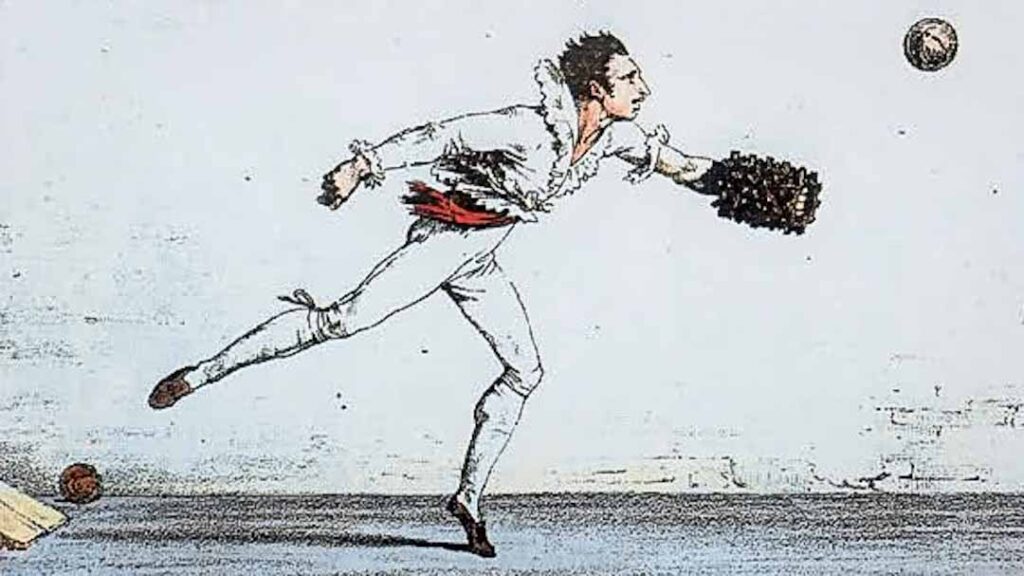
A notable Renaissance descendant was pallone col bracciale (the ball with a cuff).
Players wore a heavy wooden cuff, the bracciale, to strike a leather ball. The game was popular across central and northern Italy from the 16th century. It survived in pockets as a festival sport and regional tradition, for example in towns like Treia and Mondolfo.
In Florence, a form of street football evolved into calcio storico.
Calcio storico mixed ball play with wrestling and mass physical contest. It had codified rituals by the Renaissance and is still staged today as a civic spectacle in Piazza Santa Croce.
The arrival of the modern game
The organisation we now call modern football arrived in the late 19th century. English sailors, merchants and workers introduced codified rules and club culture. Genova is usually credited as the site of Italy’s first organised club life. The English community there founded the Genoa Cricket & Football Club, which helped spread the new game.
Similar developments happened in Milan and Turin, industrial and port cities with strong foreign links.
Once clubs formed, competitions spread fast.
The FIGC (Italian Football Federation) created national structures and championships.
By the early 20th century, football had become mass culture across Italy.
From the 1960s to the contemporary era
From the 1960s onward, Italian football entered a modern, televised era.
Television and larger stadia made major clubs national symbols. The post-war decades produced iconic teams and defining moments.
Il Grande Torino (the Torino side of the 1940s) had dominated earlier, before the Superga air disaster in 1949 ended that chapter and left a deep mark on Italian football memory.
In the 1960s and 1970s, clubs like Juventus continued to build national records. Juventus later became the dominant force in Serie A, collecting multiple titles across decades and ultimately holding the record number of championships.
There were also surprising champions that won the title as underdogs. Hellas Verona won the Scudetto in 1985, a shock that still lives in memory. Sampdoria lifted the title in 1991, another example of a smaller club rising to the top with the right management and a strong squad.
The Berlusconi era at AC Milan (from 1986) was transformative. Under Silvio Berlusconi’s ownership and with managers like Arrigo Sacchi and later Fabio Capello, Milan became a European powerhouse.
Tactical innovation fuelled by heavy investment led to domestic and international success through the late 1980s and 1990s.
Players and coaches who shaped modern Italian football
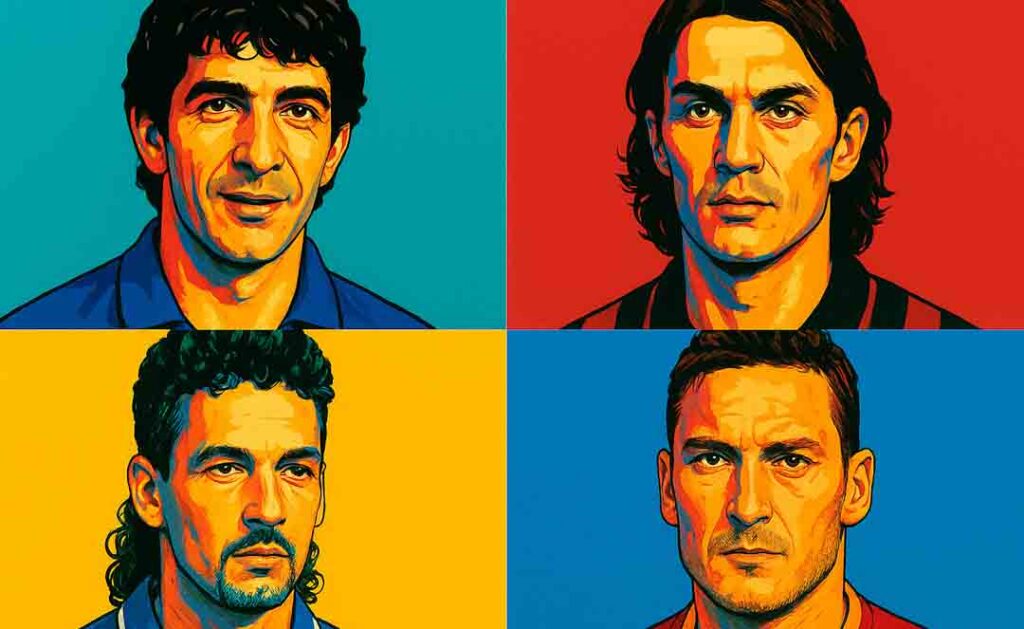
A few players and coaches left outsized marks on Italy’s football culture.
Key players:
- Gianni Rivera: creative midfielder associated with Milan and the national team; symbol of classical Italian technique.
- Gigi Riva: legendary striker for Cagliari and Italy; Italy’s all-time leading scorer for many years and a central figure in Cagliari’s 1970 Serie A title.
- Paolo Rossi: the hero of the 1982 World Cup, where Italy won and Rossi became a national icon.
- Roberto Baggio: a talismanic figure of the 1990s, widely celebrated for his technique and aura.
- Paolo Maldini: arguably the best defender in the world, member of the Maldini football dynasty.
- Francesco Totti: the Roman symbol and a modern example of club loyalty and local identity.
Influential coaches:
- Nils Liedholm: Swedish coach who influenced Italian tactics and professionalism.
- Arrigo Sacchi: revolutionary for his pressing, zonal marking and tactical cohesion at Milan. His work defined late-20th-century strategy and teams physical prep.
- Fabio Capello: pragmatic and successful, Capello won multiple league titles with different clubs.
- Zdeněk Zeman: known for his attacking philosophy and high-tempo play, particularly influential in the 1990s and 2000s.
These figures helped define different eras: technical excellence, tactical revolution, and commercialised club football.
Italian Football Today
Just like all major European leagues, Serie A and Italian football in general have changed from local spectacle to a mass media product. Television, sponsorship and social media platforms have changed clubs into brands. Clubs like Juventus have even redesigned their badge into a more marketable logo. Big games between Italian clubs have been played abroad, generating high revenue and big broadcast deals.
👉 Related: Italian Football’s Hidden World: The Minor Leagues Explained
Key Takeaways
- Harpastum and medieval ball games show that Italy had a long history of team ball-play before the modern era.
- Calcio storico and pallone col bracciale are living reminders of these older traditions.
- Modern football arrived with English clubs in port and industrial cities, then spread into national leagues.
- From the 1960s on, football grew into a televised, commercial sport shaped by great players and visionary coaches. Local passion and media influence kept the game rooted in place.