
If you’re from one of Italy’s big cities, chances are your team plays regularly in Serie A.
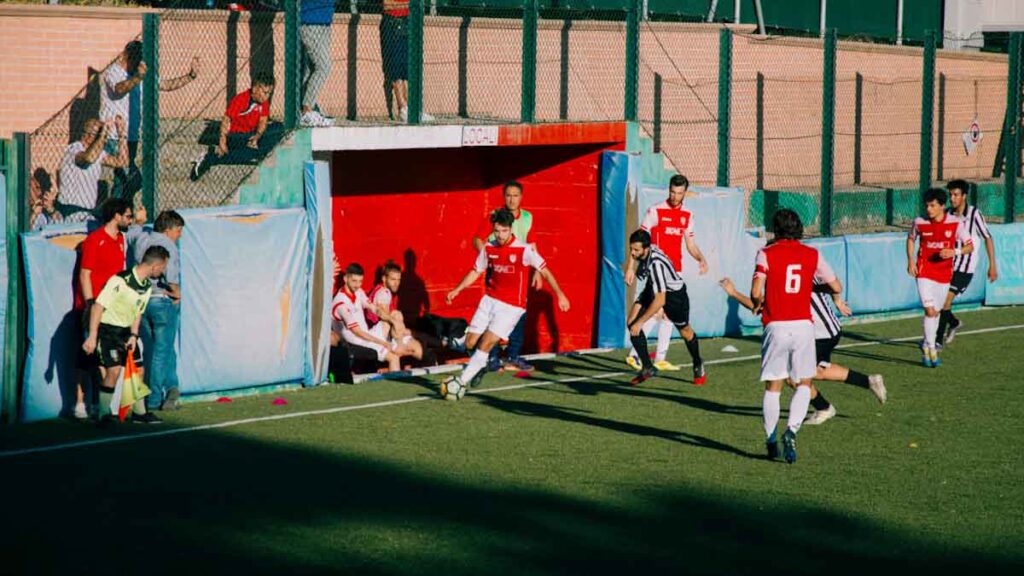
However, that’s only the tip of the iceberg of Italian football. Most mid-sized cities and provincial capitals have their own club floating between Serie B, Serie C, or even further down, at amateur level. This is the world of the Italian minor leagues, a fascinating system that holds together century-old stories and a pure love for the game.
Let’s explore it together to find out how it truly works.
👉 Related: Football in Italy: Why Calcio is More Than a Game
A Short History of Italy’s League Pyramid
The first organized football games in Italy date back to 1898, when the Federazione Italiana Giuoco Calcio (FIGC) held a small tournament called Prima Categoria.
Over time, this structure evolved into the pyramid we know today.
By 1929, Serie A and Serie B were formalized as the main national competitions, followed by the birth of Serie C in 1935 and Serie D in 1959, the bridge between the pro and amateur worlds.
From there, the Italian football system expanded outward and downward, reflecting Italy’s regional and complex geography.
👉 Related: The Birth and History of Football in Italy
How Italy’s Football Leagues Work
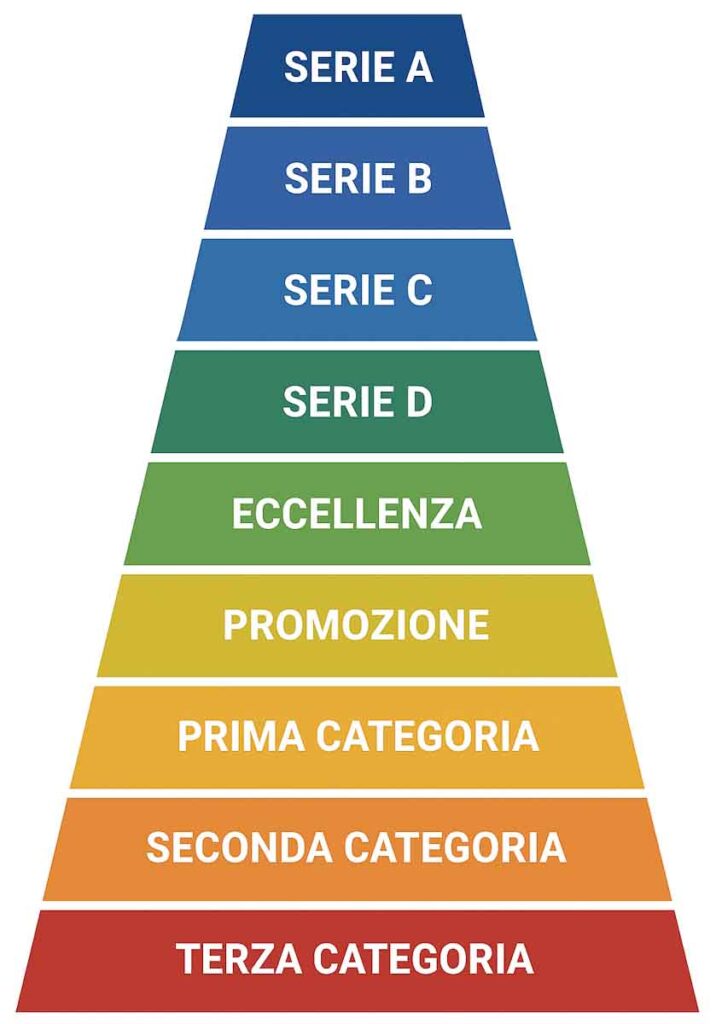
Here’s how the Italian football pyramid looks today: nine levels deep, with Serie A at the top and the legendary Terza Categoria at the bottom.
Serie A
Needs no introduction. The top tier of Italian Football. The first 4 teams qualify for the Champions League each year, with an option for a fifth depending on performance. The bottom 3 get relegated to Serie B.
Serie B (Level 2)
The nationwide second tier.
20 teams play 38 matches each.
The top two earn automatic promotion to Serie A, while the third place is decided through playoffs (3rd–8th).
At the bottom, three teams are relegated to Serie C, with a play-out between 16th and 17th if their point gap is small.
Serie B football is extremely competitive. Many clubs here are former giants or sleeping powers.
🏆 Did You Know? Serie B Players Who Wore the Azzurri Shirt
Some Italian players have been called up to the National team while playing in Serie B, rare events in Italian football history.
- Raffaele Costantino – Bari (1929): The first ever player selected for the Azzurri from Serie B, debuting in a friendly against Portugal.
- Franco Baresi – AC Milan (1980–81): Stayed loyal to Milan after relegation and earned an Italy call-up during the club’s Serie B season.
- Alessandro Del Piero – Padova (1995): Received his first Italy caps while still a young prospect in Serie B before moving to Juventus.
- Massimo Maccarone – Empoli (2002): Selected by coach Trapattoni after an explosive 19-goal season in Serie B, debuting against England.
- Gianluigi Buffon – Juventus (2006–07): Remained Italy’s first-choice keeper despite Juve’s demotion to Serie B after Calciopoli.
- Fabio Cannavaro – Juventus (2006–07): The 2006 Ballon d’Or winner captained Italy while officially a Serie B player.
- Gianluca Zambrotta – Juventus (2006–07): Also featured in Italy’s Euro qualifiers during Juventus’s Serie B campaign.
- Sandro Tonali – Brescia (2018): Called up by Roberto Mancini for a national training camp while still in Serie B.
- Honourable mention: Luca Toni – Palermo (2004): Earned his first Italy call-up soon after leading Palermo to promotion with 30 Serie B goals.
Serie C (Level 3)
Organized by Lega Pro, Serie C is split into three groups of 20 clubs each, often by geography (North, Center, South).
Three group winners go up to Serie B, while another earns promotion through a massive playoff among runners-up.
Relegation is brutal: nine teams drop to Serie D each year.
Despite being the third tier, Serie C often has strong fan bases and historic rivalries.
Cities like Avellino, Catania, and Taranto can fill stadiums with thousands even in this league.
Serie D (Level 4)
Known as “Il Campionato D’Italia”, Serie D is the top amateur division, with nine regional groups and about 162 clubs.
Winners of each group are promoted to Serie C, while the bottom sides face relegation to Eccellenza.
The nine champions also play a mini-tournament for the Scudetto Dilettanti, the amateur “title” of Italy.
Serie D is a bridge — many professional players start here, and local legends often end their careers in these divisions.
Eccellenza (Level 5)
The heart of regional football.
28 divisions, almost 500 clubs.
Each division champion goes up to Serie D, with a few others promoted through playoffs and the Coppa Italia Dilettanti.
It’s competitive, physical, and full of colorful characters.
This is where football feels most authentic — small-town stadiums, lifelong fans, and players balancing football with day jobs.
Promozione, Prima, Seconda & Terza Categoria (Levels 6–9)
Below Eccellenza, everything becomes truly local.
- Promozione (Level 6): Around 900 clubs.
Winners move up, while three per group drop to Prima Categoria. - Prima Categoria (Level 7): Over 1,600 clubs.
Promotion for group champions, relegation for the bottom few. - Seconda Categoria (Level 8): Around 3,000 clubs.
True community football, often run entirely by volunteers. - Terza Categoria (Level 9): The lowest official tier.
No relegation, only promotion — pure passion.
At these levels, football isn’t a job. It’s a ritual, a weekly escape, and a link between generations.
Historic Clubs, Glorious and Forgotten
Some of Italy’s oldest and most storied clubs now play far from the top.
- Pro Vercelli (1892): Seven-time Italian champions before 1920.
- Alessandria (1912): A classic grey-shirt team that once hosted legends like Gianni Rivera.
- Novara (1908): A name that echoes between Serie A and Serie C through decades of rebirth.
- Palermo, Avellino, Catania, Taranto: Southern powerhouses with loyal crowds, sometimes outdrawing Serie A teams in attendance.
- Fiorentina and Napoli: Two famous examples of top clubs reborn from lower tiers after bankruptcy, proving that passion survives even through collapse.
Juventus Next Gen and The Other Reserve Teams
In 2018, rules were changes to allow Serie A clubs to create their own reserve teams in serie C. This is an effort to modernise the youth system, adopting the existing Spanish and Portuguese models.
Juventus was the first one created a “B” team (Juventus U23, then renamed Juventus Next Gen) to compete in Serie C. The team won their first trophy (Coppa Italia Serie C) in 2020 (Wikipedia).
Other clubs have followed their steps since: Atalanta under 23 was founded in 2023, Milan Futuro in 2024, and Inter U23 in 2025.
Why the Minor Leagues Matter
For many Italians, these leagues are the soul of football.
They represent a form of loyalty untouched by television rights or billionaire owners.
Supporting a small team means celebrating muddy pitches, long bus rides, and the dream of one day seeing your club rise to Serie B — maybe even Serie A.
From Terza Categoria to Serie C, the common thread is community pride.
Players might not be famous, but they wear their town’s name on their chest — and that still means something.
👉 See Also: Italian Football Fans: The Ultras Explained
Key Takeaways
- Italy’s football system has 9 official levels, connecting small villages to the national stage.
- Clubs like Pro Vercelli and Alessandria are part of a living football heritage.
- Serie D is the highest amateur league, often just as passionate as the pros.
- Even after financial collapse, clubs like Napoli and Fiorentina showed how rebirth is possible.